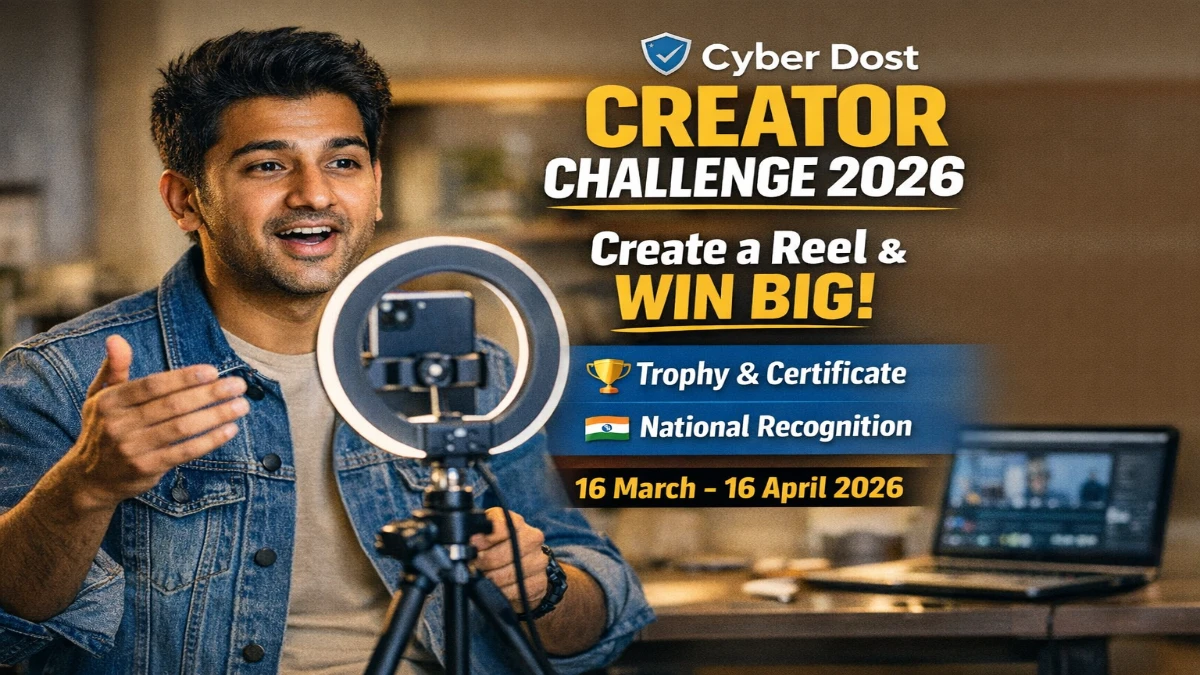
The Government of India has opened a rare opportunity for creators, students and digital storytellers across the country. Indian Cyber Crime Coordination Centre (I4C), under the Ministry of Home Affairs, has launched the National Mission Against Cyber Frauds Creator Challenge 2026, a contest where anyone can participate by making a short awareness video on cyber fraud, and the top three winners will receive a trophy, an official certificate from MHA and a collaboration feature on Cyber Dost’s government social media handles.
The submission window runs from 16 March 2026 to 16 April 2026, and the contest is open to all Indian citizens regardless of whether they are professional creators or first-time video makers.
- Why the Government Is Running a Creator Contest
- Who Can Participate
- Contest Period and Key Dates
- What You Need to Make Your Video About
- Submission Guidelines
- How to Submit Your Entry
- Prizes and What Winning Actually Means
- Practical Tips for a Strong Entry
- Cyber Dost I4C Official Handles
- FAQs
- Final Note
Why the Government Is Running a Creator Contest
Cyber fraud in India is no longer a niche digital problem. According to data from the National Cyber Crime Reporting Portal, Indians reported losses of over Rs. 11,000 crore to cyber fraud in 2023 alone, and the numbers have only grown since. Digital arrest scams, fake investment platforms, sextortion calls and KYC fraud are now among the fastest-growing crime categories in the country.
The challenge with awareness campaigns has always been reach. Official advisories, helpline numbers and government press releases exist, but they rarely reach the people who are most at risk, which are first-time smartphone users, elderly citizens and people in semi-urban and rural areas who consume content primarily through short-form videos.
This is exactly what the Creator Challenge is trying to solve. I4C wants creators to translate complex fraud mechanics into simple, relatable 90-second reels that a mother, a shopkeeper or a college student can immediately understand and act on. The government recognises that one well-made reel reaching 50,000 people can prevent more fraud than a dozen press releases.
Who Can Participate
The contest is open to all Indian citizens. There is no requirement for a professional background, a minimum follower count or prior content creation experience. Students, amateur creators, journalists, educators and anyone who can make a video are eligible.
The only baseline requirement is that participants must follow Cyber Dost I4C’s official social media handles before submitting their entry. This is to ensure that updates, shortlisting notifications and winner announcements can reach participants easily.
Contest Period and Key Dates
| Detail | Information |
|---|---|
| Contest Start | 16 March 2026 |
| Contest End | 16 April 2026 |
| Open To | All Indian Citizens |
| Video Duration | Maximum 90 seconds |
| Format | 9:16 Vertical (Reels/Shorts) |
| Language | Hindi, English or any Indian regional language |
What You Need to Make Your Video About
I4C has identified four specific scam categories for this contest. These are the fraud types that have generated the highest number of complaints on the National Cyber Crime Reporting Portal over the past year.
Digital Arrest Scam
In this scam, callers pretend to be officers from CBI, ED, Customs or the Police. They put victims on a video call and claim that the person is under “digital arrest” for some fabricated crime like a parcel containing drugs or illegal money transfers. Victims are kept on call for hours, sometimes days, and are pressured into transferring large sums of money to avoid “legal action.”
Investment Scam
Fraudsters create WhatsApp and Telegram groups that appear to offer legitimate stock tips, cryptocurrency schemes or “high return guaranteed” investment platforms. Victims are initially shown small profitable returns to build trust, after which they are persuaded to invest larger amounts that are never recovered.
Sextortion Scam
In this scam, victims receive video calls where the caller appears intimate or compromised, and the call is secretly screen-recorded. The recorded footage is then used to blackmail the victim into sending money. This particular scam has led to a disturbing number of suicides across India.
KYC Update Scam
Scammers impersonate representatives from banks, Aadhaar, or digital wallets and claim that the victim’s account will be blocked unless they complete a KYC update immediately. This urgency tricks victims into sharing OTPs, banking credentials and account details.
A strong entry will pick one of these four scams, accurately show how the scam actually works from the fraudster’s side, and then clearly explain the correct way to avoid it or respond to it.
Submission Guidelines
Before you start shooting, here are the technical and content rules that every participant must follow.
Video Format and Length
The video must be in 9:16 vertical format. This is non-negotiable because the content is specifically for Instagram Reels, YouTube Shorts and similar short-form vertical platforms. The maximum duration is 90 seconds. A video that is sharp, focused and gets to the point within 60 to 90 seconds will always perform better than one that stretches the message thin.
Language
You can create your video in Hindi, English or any Indian regional language. Regional language entries are particularly encouraged because they reach audiences in areas where cyber fraud awareness is lowest and the actual impact of the content is highest.
Originality
Your content must be entirely original and self-created. You cannot use copyrighted music, visuals or clips without explicit permission. Use royalty-free music tracks to stay within eligibility rules. Copyrighted background audio is one of the most common reasons for disqualification in creator contests.
Tone and Responsibility
The content should be respectful and responsible. Avoid fear-mongering, sensationalism or exaggerated dramatisation. The goal is awareness, not panic. Your video should leave the viewer with a clear, actionable understanding of how to protect themselves.
How to Submit Your Entry
The submission process has two steps.
Step 1: Post Your Video on Social Media
Upload your video on any one of these platforms: Instagram, Facebook, X (Twitter) or YouTube. The account must be public. In your post caption, tag @CyberDost and use the hashtag #CreatorsAgainstCyberCrime. Both the tag and the hashtag are mandatory.
Step 2: Fill the Official Google Form
After posting, submit your entry through the official Google Form at: https://forms.gle/stjnzufyTxznaBtC9
In the form, you will need to provide your full name, contact information and the public link to your video.
If you want to submit more than one video, all entries must be included in a single submission. You cannot fill the form separately for each video.
Official guidelines and the full PDF notification are available at i4c.mha.gov.in.
Prizes and What Winning Actually Means
The top three entries will receive three rewards.
1. Trophy and Official Certificate from MHA
Winners will receive a physical trophy or memento along with an official certificate from I4C, Ministry of Home Affairs. For any creator building a credible portfolio, a certificate from MHA carries significant weight, particularly for students, journalists and those looking to work in public communication or digital policy roles.
2. Exclusive Cyber Dost Merchandise
Winners will receive a branded merchandise gift hamper from Cyber Dost I4C.
3. Collaboration Feature on Official Government Handles
This is arguably the most valuable prize. Winning content will be shared as a collaboration on Cyber Dost I4C’s official social media platforms. For a small or mid-size creator, being featured on a government handle with lakhs of followers provides organic reach that no paid campaign can replicate. This kind of government-validated visibility is a genuine career boost.
Practical Tips for a Strong Entry
Accuracy over drama
The scam you choose to cover must be shown accurately. The goal is to educate, not to entertain through exaggeration. Inaccurate portrayals of how scams work can actually mislead people, which is the opposite of the contest’s purpose.
Structure your 90 seconds
A strong script follows a simple arc: show the problem, explain how the scam works from the fraudster’s angle, then deliver the specific protection step the viewer should take. This three-part structure works consistently in awareness content.
End with a clear call to action
Every entry should mention the 1930 national cyber helpline or the portal cybercrime.gov.in at the end. This gives viewers an immediate next step and signals to evaluators that your content is practically useful, not just visually appealing.
Regional language is a competitive advantage
If Hindi or English is not your strongest language, create in your regional language. These entries often reach the most vulnerable and underserved audiences, which aligns directly with what I4C is trying to accomplish with this challenge.
Cyber Dost I4C Official Handles
| Platform | Handle |
|---|---|
| @cyberdosti4c | |
| X (Twitter) | @Cyberdost |
| YouTube | @cyberdosti4c |
| CyberDostI4C |
FAQs
Is this contest only for professional creators? No. The contest is open to all Indian citizens including students, amateur creators and anyone who can make a video. A professional background is not required.
Can one creator submit more than one video? Yes, but all videos must be included in a single submission through the Google Form. Separate forms for separate videos are not accepted.
Which platform should I upload my video to? You can upload to Instagram, Facebook, X or YouTube. The account must be public and the video link must be included in the submission form.
Are regional language videos accepted? Yes. Hindi, English and any Indian regional language are all accepted.
How will winners be selected? I4C will evaluate entries based on originality, clarity of the awareness message, potential impact and overall production quality.
What is the submission deadline? The contest closes on 16 April 2026.
Final Note
The National Mission Against Cyber Frauds Creator Challenge is not a typical social media contest. It is a government-backed public awareness mission where your creativity directly translates into protection for real people. Every reel that stops one person from transferring money to a fake CBI officer, or one person from sharing their OTP to a fake bank representative, is a reel that has done its job.
If you are a student, a content creator or simply someone who wants to contribute meaningfully to digital safety in India, this is a genuinely worthwhile opportunity with real recognition attached to it.
For a detailed breakdown of this scheme in Hindi, including a step-by-step guide to participation, you can also refer to this comprehensive coverage on ProjectSarthi: National Mission Against Cyber Frauds Creator Challenge 2026 – Full Guide







No Comments