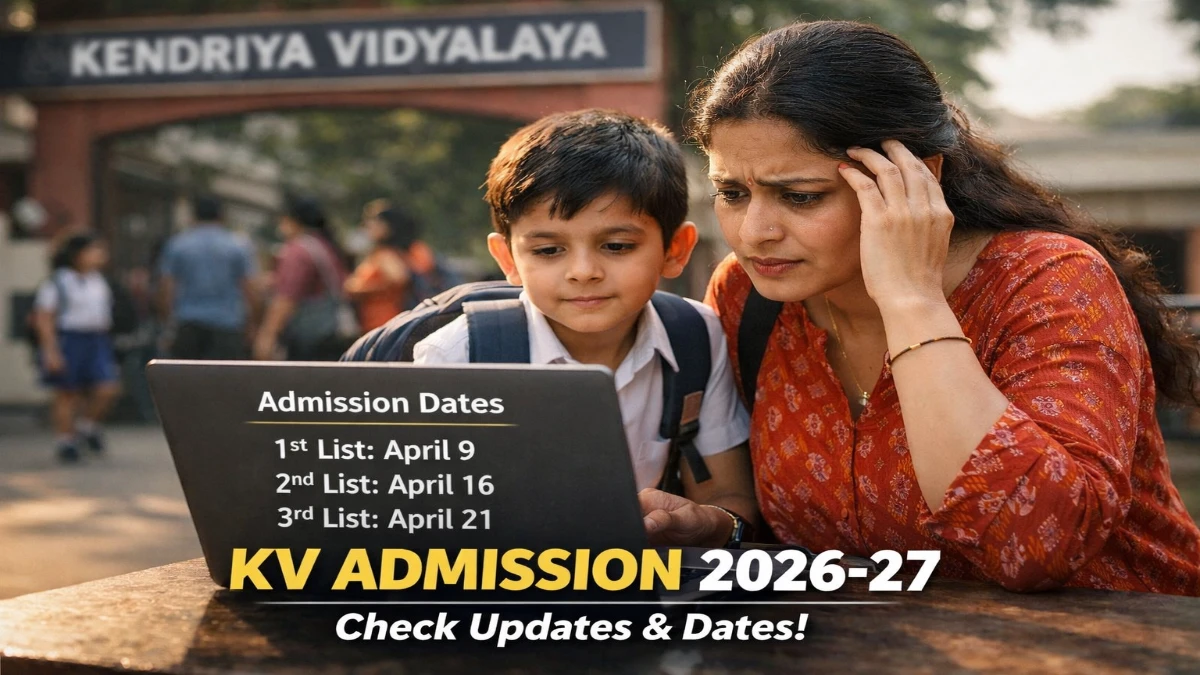
The Kendriya Vidyalaya Sangathan (KVS) has officially opened admissions for the academic year 2026-27. The Class 1 provisional list has already been released, the second provisional list is scheduled for April 16, and the third for April 21. If you have submitted an application or are planning to apply, this guide covers everything you need to understand the process, timelines, eligibility, seat reservations, fee structure, and how to improve your child’s chances of getting in.
Kendriya Vidyalayas are among the most sought-after government schools in India, not just because of the quality of education but because of the fee structure and CBSE-aligned curriculum. With over 1,200 KVs operating across India and abroad, the annual admission season attracts millions of applications, making it competitive even for the priority categories.
- Complete KV Admission Schedule 2026-27
- KV Admission Eligibility Criteria 2026-27
- Who Gets Admission First? The Priority System Explained
- Seat Reservation Structure: What the Numbers Actually Mean
- Transfer Certificate (TC) Based Admissions
- Admissions to Classes 2 Through 8 (Subject to Vacancy)
- Class 9 Admission: The Entrance Test Process
- Class 11 Admission: Stream Cutoffs and the Two-Stage Process
- Fresh Admission in Classes 10 and 12
- KV Fee Structure 2026-27
- How to Register Online for KV Admission 2026-27 (Step-by-Step)
- Documents Required for KV Admission
- How to Check KV Admission Application Status
- Class-wise Admission Process at a Glance
- Preparing for Class 9 Entrance Exam: What to Focus On
- Strategies to Improve Class 1 Admission Chances
- What Happens After Your Child's Name Appears in the List
- Contact and Official Resources
- Frequently Asked Questions
- Conclusion
Complete KV Admission Schedule 2026-27
The admission process follows a strict calendar. Missing any date means missing the window entirely, so tracking these dates carefully is critical.
| Event | Date |
|---|---|
| Admission advertisement | March 19, 2026 |
| Online registration open (Balvatika 1 & 3 and Class 1) | March 20, 2026 |
| Last date of online registration (Balvatika 1 & 3 and Class 1) | April 2, 2026 |
| 1st Provisional List (Balvatika 1, 2, 3) | April 8, 2026 |
| 1st Provisional List (Class 1) | April 9, 2026 (April 10 for Assam, Kerala, Puducherry) |
| 2nd Provisional List (if seats vacant) | April 16, 2026 |
| 3rd Provisional List (if seats vacant) | April 21, 2026 |
| Offline registration for RTE/SC/ST/OBC (if needed) | April 22-26, 2026 |
| Display of list and admissions | April 27-30, 2026 |
| Registration for Balvatika 2 and Class 2 onwards (offline, subject to vacancy) | April 2-8, 2026 |
| Declaration of list for Class 2 onwards | April 13, 2026 |
| Admission for Class 2 onwards | April 15-20, 2026 |
| Last date of admission (except Class 11) | June 30, 2026 |
| Last date with special approval (if seats vacant) | July 31, 2026 |
| Registration for Class 11 (KV students) | Within 10 days after Class 10 results |
| Admission for Class 11 (KV students) | Within 20 days after Class 10 results |
| Last date of admission for Class 11 | 30 days after CBSE Class 10 result declaration |
One important note here: the second and third provisional lists are only released if seats remain vacant after the previous list. In most popular KVs in metro cities, the process ends at the first list itself. In smaller towns and cantonment areas, subsequent lists are more common.
KV Admission Eligibility Criteria 2026-27
Eligibility for KV admission has two main components: citizenship and age. Both must be satisfied simultaneously.
Citizenship Requirement
For admission to KVs located within India, the candidate must be an Indian citizen. For KVs located abroad, this requirement does not apply in the same way since those schools also admit wards of foreign nationals on deputation.
Class-wise Age Criteria
The age is calculated as of March 31 of the admission year. A child born on April 1 is included and treated as turning the relevant age by March 31 of that academic year.
| Class | Minimum Age | Maximum Age |
|---|---|---|
| Class 1 | 6 years | Less than 8 years |
| Class 2 | 7 years | Less than 9 years |
| Class 3 | 7 years | Less than 9 years |
| Class 4 | 8 years | Less than 10 years |
| Class 5 | 9 years | Less than 11 years |
| Class 6 | 10 years | Less than 12 years |
| Class 7 | 11 years | Less than 13 years |
| Class 8 | 12 years | Less than 14 years |
| Class 9 | 13 years | Less than 15 years |
| Class 10 | 14 years | Less than 16 years |
| Class 11 | No restriction | No restriction |
| Class 12 | No restriction | No restriction (no break in studies after Class 11) |
Children with disabilities (CwSN) are eligible for a relaxation of up to 2 years in the upper age limit, granted at the Principal’s discretion on a case-by-case basis.
Who Gets Admission First? The Priority System Explained
This is the section that most parents misunderstand. KV admission does not work on a first-come-first-served basis. It works on a priority category system where seats are distributed across categories in a defined sequence.
Priority Order Under Civil and Defence Sectors
Priority 1: Wards of transferable and non-transferable Central Government employees, ex-servicemen, and defence personnel. This also includes children of Foreign National Officials on deputation to India at the Government of India’s invitation.
Priority 2: Children of transferable and non-transferable employees of Autonomous Bodies, Public Sector Undertakings (PSUs), and Institutes of Higher Learning under the Government of India.
Priority 3: Children of transferable and non-transferable State Government employees.
Priority 4: Children of employees of State Government Autonomous Bodies, PSUs, and Institutes of Higher Learning.
Priority 5: Children of Foreign Nationals residing in India, considered only when no Indian national is on the waitlist.
Within Priority 1, there is an additional sub-ranking: preference is given based on the number of transfers the parent has undergone in the last 7 years. More transfers mean higher priority. This is why submitting a detailed service certificate showing transfer history is so important.
Seat Reservation Structure: What the Numbers Actually Mean
Each KV class has 40 seats in standard intake. The reservation structure determines how those 40 seats are distributed.
| Category | Seats Reserved | How Selection Happens |
|---|---|---|
| RTE (Right to Education) Quota | 25% of seats (approximately 10 seats) | Lottery among SC/ST/OBC-NCL/EWS/BPL/CwSN children living nearby |
| Scheduled Caste (SC) | 15% (approximately 6 seats) | Reserved quota per central norms |
| Scheduled Tribe (ST) | 7.5% (approximately 3 seats) | Reserved quota per central norms |
| OBC (Non-Creamy Layer) | 27% (approximately 11 seats) | Reserved quota per central norms |
| Children with Special Needs (CwSN) | 3% of total seats | Distributed across all categories |
| Single Girl Child (SGC) | 2 seats per class | Within general or reserved categories |
The RTE quota is particularly important to understand. Under the Right to Education Act 2009, 25% of seats in every KV must be allocated to children from economically weaker sections and disadvantaged groups living in the neighbourhood of the school. If your child falls in the SC, ST, OBC-NCL, EWS, or BPL category and you live near a KV, this quota can significantly improve admission chances. Parents applying for RTE seats in KVs should also check state-level RTE admission processes, as states like UP, Rajasthan, and Maharashtra run separate RTE admission programmes for private schools that can run alongside KV admissions.
Transfer Certificate (TC) Based Admissions
This is a provision that is extremely useful for Central Government and defence employees who transfer frequently and need to move their child mid-year or at year-start to a new station’s KV.
When a parent is transferred, the ward gets automatic admission to the KV at the new station, even if the class is full. This admission is granted over and above the sanctioned strength of the class, meaning it does not take a seat away from any existing student. The only requirement is that the child was previously studying in a KV.
Defence and paramilitary personnel have an additional provision: children of personnel posted in Naxal-affected areas can get admission in any KV of their preference, not limited to the posting station. This needs approval from the Deputy Commissioner of the relevant KV region.
Admissions to Classes 2 Through 8 (Subject to Vacancy)
For Classes 2 to 8, there is no entrance exam and no online registration portal. These admissions are purely based on seat availability and are conducted offline at the school level.
The process works as follows: KVS declares the number of vacant seats for each class after the Class 1 and Balvatika admission process concludes. Parents must then approach the school directly during the specified window (April 2-8, 2026 for registration, with admissions from April 15-20). If the number of applicants for a vacant seat exceeds availability, a lottery is conducted within each priority category.
The important thing to note is that priority categories still apply. A child of a Central Government employee will be considered before a child from the private sector even for these vacancy-based admissions.
Class 9 Admission: The Entrance Test Process
Admission to Class 9 is through an entrance exam conducted at the school level, but only when seats are vacant. The exam is based on the CBSE Class 8 syllabus and covers five subjects.
Exam Format: Total marks 100, duration 3 hours, conducted in English and Hindi medium. Each subject carries 20 marks. Qualifying marks are 33% for general category, and 25% for SC/ST and Divyang (differently-abled) candidates.
Subjects covered: English, Hindi, Mathematics, Science, and Social Science (History, Geography, Civics). While an official 2026-27 syllabus has not been centrally published yet, the pattern follows the NCERT Class 8 curriculum.
To prepare for this exam, students should focus on NCERT textbooks from Class 8 across all five subjects. Sample papers and previous year question papers are available on the KVS portal and through the individual school websites.
Class 11 Admission: Stream Cutoffs and the Two-Stage Process
Class 11 admissions follow a two-phase approach: KV students are given priority in the first phase, and non-KV students are considered in the second phase only if seats remain vacant after all eligible KV students are accommodated.
Registration for KV students opens within 10 days of the CBSE Class 10 result declaration and admissions are completed within 20 days of results. Non-KV students must wait until that process concludes.
The stream-based cutoffs for Class 11 are as follows:
Science stream: Minimum 60% aggregate in the best five subjects in Class 10. For SC/ST/OBC/CwSN/Sports/NCC candidates, relaxation in cutoff marks is applicable.
Commerce stream: Minimum 55% aggregate in the best five subjects in Class 10.
Humanities stream: Open to all students who have passed Class 10 regardless of marks. This makes it the most accessible stream for non-priority category students seeking KV Class 11 admission from outside the school.
One important consideration: students from State Boards, ICSE, or NIOS who want to transfer into KV for Class 11 must ensure that the subject combination they want is available in that particular KV. Not every KV offers every stream combination, and once admitted, subjects cannot easily be changed.
Fresh Admission in Classes 10 and 12
KV does not freely grant fresh admissions to Classes 10 and 12. These are considered only under specific conditions and require approval from the Deputy Commissioner of the concerned KV region.
For Class 10 fresh admission, the class strength must be below 40. The student must be from a CBSE-affiliated school and must have scored a minimum of 55% in Class 9. The subjects they wish to study must be available in that KV.
For Class 12, the same 55% condition applies for Class 11 performance, the class must be below 40 in strength, and the subject combination must be available. These fresh admissions are genuinely rare and generally happen only in KVs in smaller towns where demand is lower.
KV Fee Structure 2026-27
One of the biggest draws of KV education is the affordable fee structure. Here is how it works.
There is no tuition fee for girls at any level. SC/ST students and children of KVS employees are also fully exempt from tuition fees. For boys, tuition fees apply only from Class 9 to Class 12.
A Computer Fund is collected from all students in Class 3 and above. Every student across all classes contributes to Vidyalaya Vikas Nidhi (VVN), which funds the school’s infrastructure and development needs. The total monthly fee for most students falls in the range of Rs. 500 to Rs. 1,200 depending on the class and applicable exemptions. The admission application itself is free of cost.
How to Register Online for KV Admission 2026-27 (Step-by-Step)
The online registration portal is kvsonlineadmission.kvs.gov.in. Here is the complete process:
Step 1: Read Instructions on the Portal
When you open the portal, a detailed instructions page loads first. You must read and understand all guidelines before proceeding. At the bottom of the page, there is a declaration checkbox. Only after checking this box does the “Proceed” button become active. Skipping this step means you cannot move forward.
Step 2: Create a New Account (First-Time Registration)
First-time users must sign up by entering the child’s full name exactly as on the birth certificate (this cannot be changed later), date of birth, CwSN status if applicable, KVS employee details if applicable, a valid email address, and an active mobile number with an Indian SIM. You will also need to upload a scanned copy of the child’s birth certificate in JPEG format with a maximum file size of 256KB. After submitting the registration form and entering the captcha, enter the OTP sent to your mobile number. A unique Login Code is generated upon successful registration. Save this Login Code carefully because it is needed every time you log in.
Step 3: Log in Using the Login Code
To log in after registration, enter the Login Code generated during sign-up, the child’s date of birth exactly as entered during registration, and the registered mobile number. All three must match. There is no password in the traditional sense; the Login Code replaces it.
Step 4: Fill the Application Form
The application form has five sections presented as separate tabs: Basic Information, Parents’ Details, Choice of Schools, Upload Documents, and Declaration and Submit. You can apply to a maximum of three Kendriya Vidyalayas in one application. Save progress after completing each section before moving to the next. Fields like name, date of birth, and contact details that were set during registration cannot be changed at this stage.
Step 5: Upload Documents
Each required document must be uploaded in the correct slot. Most documents need to be in JPEG or PDF format within the file size limits specified on the portal. Blurry or partially visible documents may cause verification problems later, so use clear scans or well-lit photographs.
Step 6: Review and Submit
Before final submission, review every field carefully. Pay particular attention to the service certificate details since these determine priority category placement. Once submitted, an acknowledgement slip is generated with an application number. Download and save this slip.
Documents Required for KV Admission
All documents must be self-attested by the parent or guardian. Originals must be carried to the school at the time of physical verification.
Birth Certificate: Issued by the competent authority such as a municipal corporation, village panchayat, military hospital records, or defence service records. The name and date of birth on this document are final and used throughout the admission process.
Aadhaar Card: Serves as both identity proof and residence proof for the child.
Service Certificate: Critically important for employees claiming Priority 1 or 2 status. Must be signed and stamped by the head of office. Must clearly state the employee’s name, designation, and the total number of transfers during the preceding 7 years. More transfers in the past 7 years means higher sub-priority within the same category.
Caste Certificate: For SC/ST/OBC-NCL applicants. Must be issued by the competent authority in the concerned state or union government.
Disability Certificate: Issued by a civil surgeon, rehabilitation centre, or government-approved authority. Exception: blind students are verified in person and approved by the Principal directly.
Retirement Certificate: For ex-servicemen claiming the transferable government employee priority, a retirement certificate from the defence establishment is required.
Transfer Certificate (TC): Required when seeking admission to Class 2 or above. Must be from the last school attended.
Passport-size Photograph: Recent photograph to be affixed to the application form.
Single Girl Child Affidavit: If claiming the 2-seat Single Girl Child priority, a sworn affidavit confirming that the girl is the only child in the family is required.
How to Check KV Admission Application Status
Once you have submitted your application, you can track its status on the official portal. Go to kvsonlineadmission.kvs.gov.in and look for the “Check Application Status” option on the right side of the dashboard. Log in with your credentials and the current status will be displayed. You can also view your submitted application in full or cancel it from this section if needed.
For parents who submitted applications for multiple KVs, the status shows separately for each school selected.
Class-wise Admission Process at a Glance
| Class | Admission Process | Entrance Exam | Key Notes |
|---|---|---|---|
| Class 1 | Online lottery system | No | Priority category applies; lottery within each category if oversubscribed |
| Classes 2 to 8 | Offline, subject to vacancy | No | Priority category applies; lottery if multiple applicants for same seat |
| Class 9 | Entrance exam (if seats vacant) | Yes | 100 marks, 3 hours, 5 subjects, 33% qualifying marks (25% for SC/ST/CwSN) |
| Class 11 | Based on Class 10 board marks | No | Science: 60%, Commerce: 55%, Humanities: Open; KV students get first preference |
| Classes 10 and 12 | Transfer cases and fresh admission under vacancy conditions only | No | Needs DC approval; fresh admission only if class strength below 40 |
Preparing for Class 9 Entrance Exam: What to Focus On
Since the Class 9 entrance exam is the only academic test in the KV admission process, students appearing for it need a structured preparation approach.
The test is based entirely on NCERT Class 8 content. Students should start by completing all chapters in the NCERT textbooks for Mathematics, Science, Social Science, Hindi, and English. Do not use guide books as primary preparation material; the exam is set from NCERT and using non-NCERT material adds confusion without adding value.
For Mathematics, focus on Algebra, Geometry, Mensuration, and Data Handling as these tend to carry the most questions. For Science, pay attention to Microorganisms, Combustion, Crop Production, Metals and Non-Metals, and Force and Pressure. Social Science should be prepared across History (Colonialism, Nationalism), Geography (Resources, Industries), and Civics (Parliament, Fundamental Rights).
With 20 marks per subject and a 3-hour duration, you have roughly 36 minutes per subject. Practice solving past papers within this time constraint so that you develop a sense of pace.
Strategies to Improve Class 1 Admission Chances
For Class 1, the lottery system is used within priority categories. You cannot change your priority category, but there are things you can do to optimise your application.
First, apply to three KVs, not just one. The application form allows you to list three school preferences. A child who gets into any one of the three is a success; limiting yourself to one reduces your chances significantly.
Second, ensure your service certificate shows maximum transfer history. If the parent has had multiple transfers in the last 7 years, every transfer counts toward sub-priority within Priority 1. A certificate showing 5 transfers is ranked higher than one showing 2 transfers even though both are Priority 1.
Third, if your child qualifies for the RTE or SC/ST/OBC-NCL quota, make sure the relevant certificates are valid, current, and clearly legible. A rejected certificate means losing the reserved seat advantage entirely. For parents exploring all available school admission options under the RTE Act, state RTE admission programmes also run parallel to KV admissions and cover private schools, which is worth considering as a backup.
Fourth, check the school’s admission pattern from previous years. Some KVs in smaller stations rarely fill even the first list, meaning almost all applicants get in. Some KVs in metro cities exhaust Priority 1 and 2 seats in the first list and never reach Priority 3. Knowing this in advance helps you set realistic expectations.
What Happens After Your Child’s Name Appears in the List
Appearing in the provisional list is not the same as confirmed admission. After the list is published, you must complete physical document verification at the school within the specified window (generally April 27-30, 2026 for those appearing in the first three lists). If you miss this window, the seat is offered to the next candidate in the lottery.
During verification, bring all original documents along with self-attested photocopies. The school staff verifies the documents against the information submitted online. If any discrepancy is found between the online application and the original documents, admission may be rejected even at this stage. This is why the service certificate details, birth certificate name, and caste certificate must all be accurate at the time of initial registration.
Contact and Official Resources
For any admission-related query, the first point of contact should be the Principal of the KV you are applying to. For regional issues or escalations, the Deputy Commissioner of the relevant KV region handles the matter.
KVS Headquarters contact details:
Kendriya Vidyalaya Sangathan, 18 Institutional Area, Shaheed Jeet Singh Marg, New Delhi 110016. Phone: (+91-11) 26858570. Email: [email protected]
Official admission portal: kvsonlineadmission.kvs.gov.in
KVS main website: kvsangathan.nic.in
Frequently Asked Questions
1. My child was born on April 2, 2020. Is she eligible for Class 1 admission in 2026-27?
No. The age is calculated as of March 31, 2026. A child born on April 2, 2020 will be 5 years and 11 months on March 31, 2026, which falls short of the minimum 6-year requirement. She will be eligible for Class 1 admission in 2027-28.
2. I work in a private company. Can I apply for KV admission for my child?
Yes. KV admissions are not restricted to government employees only. Private sector children fall under Priority 5 (or lower), which means they are considered only after all government category applicants and if seats remain vacant. In popular KVs, seats rarely remain after Priority 1 and 2 are filled. In less competitive KVs, private sector children often do get admitted.
3. How many KVs can I apply to in one online form?
You can select up to three Kendriya Vidyalayas in a single online application for Class 1. Each school is listed as a preference and a separate lottery is run per school per category.
4. My child is in Class 5 at a private school. Is there any way to get admission to Class 6 in a KV?
Class 6 admission in KV is subject to vacancy. Registration is done offline at the school during the April 2-8 window. Contact the school directly after April 13 when the vacancy list is published to know if seats are open for Class 6.
5. My child did not get into KV Class 1 this year. What are my other free school options?
The RTE Act guarantees 25% free seats in private schools for children from EWS and disadvantaged backgrounds. Several states run dedicated online portals for this. The UP RTE Admission 2026 and Rajasthan RTE Admission 2026 processes are currently open and provide an alternative route to quality school education at no cost.
6. What is the difference between the 1st Provisional List and Final Admission?
The 1st Provisional List is a shortlist of children who have been selected in the lottery. It is not a final admission confirmation. Parents must appear for document verification at the school during the April 27-30 window. Only after successful document verification and payment of fees (if applicable) is admission confirmed.
7. Can a student who passed Class 10 from a State Board apply for Class 11 in a KV?
Yes, but only after all eligible KV students are given admission and seats still remain vacant. The same mark cutoffs apply: 60% for Science, 55% for Commerce, and open for Humanities. The student must have passed Class 10 from a CBSE-affiliated school for Class 10 and 12 fresh admissions, but Class 11 applicants from State Boards may be considered depending on the regional KV guidelines for that academic year.
8. Is there any scholarship specifically for KV students?
Yes, KV students with strong academic performance can apply for various central government and state scholarships. The National Means-cum-Merit Scholarship (NMMS), Central Sector Scholarship for College and University students, and several board-level merit scholarships are available. For a curated list of scholarships currently accepting applications, visit ScholarshipsFree.com India scholarships where new opportunities are updated regularly.
Conclusion
The KV admission process for 2026-27 is already underway with the first Class 1 provisional list out. If your child’s name is on the list, the priority right now is completing document verification before April 30. If the name is not on the first list, check back on April 16 and April 21 for the second and third provisional lists.
For Classes 2 to 8, the offline vacancy window opens from April 2-8 and results are declared on April 13. For Class 11, the process begins after CBSE Class 10 results are announced, typically in May or June.
The key to navigating KV admission successfully is understanding the priority system, preparing documents accurately, and being on time at every stage. One missed date or one discrepancy in a document is enough to lose a seat that was legitimately yours in the lottery.







No Comments